Stand Firm In It!

1 Peter 5:12 Through Silvanus, our faithful brother (for so I regard him), I have written to you briefly, exhorting and testifying that this is the true grace of God. Stand firm in it!

In a letter full of commands and exhortations to Christian living by faith, Peter’s concluding command is very simple yet profound: stand firm.  Maybe you are familiar with the “Full Armor of God” passage in Ephesians 6:11-17.  Paul commands that we stand firm three times in that passage, and the armor of God enables us to do so. 

“…this is the true grace of God. Stand firm in it!”

What is going on with this statement? What is Peter calling the “true grace” of God? As someone who has been captivated by the idea of GRACE all my life, I really love the sound of this command.  It is a beefy thing to say “stand firm in God’s true grace.”  Grace is not really thought of as beefy is it? I think the wisdom of the world might suggest grace is a weak thing–weakness in God for being merciful or weakness in people who delude themselves in the misguided hope of a gracious “savior.”  Peter, the rough and tough fisherman-turned-spokesman of Jesus’ disciples (and now Jesus’ Apostle to Israel), makes a strong statement about God’s mighty works and man’s access to them.

The power of the apostolic imperative is on display here in all its glory.  As Peter closes his first epistle, we find ourselves aware of a responsibility that implies great ability.   Peter answers at least three key questions by saying “stand firm in the true grace of God.”  First, we know what we are supposed to do in the situation Peter describes.  In a world of deception corrupted by Satan’s system of rebellion against God, we know our job is to hold the line, to keep the faith.  Under withering spiritual assault, stand firm. 

Second, Peter tells us something very important to our spiritual health and success by implication: You can do it.  You can stand firm.  How many times have we said, “I can’t” about something we know we are responsible to do?  You might want to cave under the pressure of the world, the flesh, and the devil, and in a moment of weakness you might want to say “I don’t know if I can do it.”  Peter does not really leave room for us to entertain the question.  You can.  Otherwise he has no business telling you to stand firm.

Third, it seems clear that Peter tells us how and where we stand firm in one little phrase: “in it.”    We stand firm in the true grace of God, and this means, in terms of location, that you stand on God’s grace and never move from it.  Stand there and enjoy God’s deliverance.  In terms of ability, I contend that Peter is saying that God’s grace enables you to stand firm.  The prepositional phrase is a double-entendre.  By God’ s grace alone are we enabled with spiritual power from the Holy Spirit through the Word to do what pleases God.  And in a 1 Peter 5:8 world, that means standing firm against our adversary.

1 Peter 5:8 Be of sober spirit, be on the alert. Your adversary, the devil, prowls around like a roaring lion, seeking someone to devour.

Now what does Peter mean by “this” and “it” when he says “This is the true grace of God. Stand firm in it“? What is the true grace of God? In Greek, the pronoun “this” modifies or refers to the word “grace, χαριςְ, both being feminine in gender. But that does not tell us what “this” is. Read it:

1 Peter 5:5-12

5 You younger men, likewise, be subject to your elders; and all of you, clothe yourselves with humility toward one another, for God is opposed to the proud, but gives grace to the humble.6 Therefore humble yourselves under the mighty hand of God, that He may exalt you at the proper time, 7 casting all your anxiety on Him, because He cares for you.

8 Be of sober spirit, be on the alert. Your adversary, the devil, prowls around like a roaring lion, seeking someone to devour.9 But resist him, firm in your faith, knowing that the same experiences of suffering are being accomplished by your brethren who are in the world.

10 After you have suffered for a little while, the God of all grace, who called you to His eternal glory in Christ, will Himself perfect, confirm, strengthen and establish you.11 To Him be dominion forever and ever. Amen.12 Through Silvanus, our faithful brother (for so I regard him), I have written to you briefly, exhorting and testifying that this is the true grace of God. Stand firm in it!

The Word of God itself, which Peter has written here, is “this” and “it.” This is the true grace of God: That Peter has been empowered and directed by the Holy Spirit to write of our salvation, our walk with God, and the associated challenges along the way. That God has revealed His will for us. That God has commanded us and empowered us, that we have a relationship with Him fed by His Word. This is the true grace of God–the Christian spiritual life of intake of the Word, the exhale of faith in it, and the practice of what it requires, all by God’s grace through the Holy Spirit.


Stand FIRM in the Word, which is God’s true grace to you!

Posted in Christian Suffering, Spirituality, Uncategorized | Tagged , , , , , , , , | 1 Comment

Dependence

What does Paul mean when he commands the Galatians to “walk by the Spirit”?

The context of Galatians 5 tells us that whatever it means, this practice is opposed to the flesh, our inner tendency to rebellion against God through arrogance and preoccupation with self.

The effects of the flesh are patterns of personal sin; the effects of the Spirit are the virtues of Jesus Christ Himself.

It can be helpful to state what this pneumatic perambulation (walking by the Spirit) is not.

  • It cannot be something you find within yourself, like your own spirit apart from God’s influence. “Walk by the Spirit” means God the Holy Spirit.
  • It cannot be unassisted intuition or mere sentiment because the desires of the flesh appeal to our affections as their primary point of attack. This is not the “feeling of the Spirit.” Every sin starts with an impulse of the feels.
  • Paul is not saying in Platonic fashion to go with your inner spiritual self as opposed to your physical body.

Walking in or by the Spirit is simply stated but profound. This is often the case: a statement’s gravity is often inversely proportional to its size.

πνεύματι περιπατείτε

Bear with me as I try to explain the nuance of two Greek words in modern English:

  • πνεύματι = PNEUMATI is the dative singular form of PNEUMA, which means “spirit.” While PNEUMA in Greek can refer to breath, wind, the human spirit, the Holy Spirit, or even worldview, here by context the reference must be to God the Holy Spirit. In this instance the dative case is used instrumentally, suggesting the means by which the verb is accomplished. “By means of the Spirit” would be a literal rendering.
  • περιπατείτε = PERIPATEITA is the plural present active imperative form of the verb PERIPATEŌ, which is a common verb in Greek for walking. The present tense on Greek with the imperative mood makes this a command of an ongoing process—“go on walking” or “be walking” as a constant mode of life. Walking is often used in both Old and New Testaments to refer to the mode of one’s life or pattern of conduct.
  • What does that give us? “By means of (God) the (Holy) Spirit be walking”

“By means of the Holy Spirit be walking”

There can only be one sense that the believer is responsible to walk by means of the Holy Spirit: dependence on His power. The means by which you walk is to be His strength, His enablement. The means by which one does anything involves the power or enablement to do that thing. This is in direct opposition to walking by means of the flesh. The energy of the flesh is useless to accomplish the will of God.

This arrangement is personal—God the Spirit is the Third Person of the Godhead. But this walk also involves mechanics—He is portrayed impersonally in terms of instrumentation or means. Obviously our volition is involved: we must choose to obey this command to walk. At the same time, the enablement or ability to walk is all from the Lord.

Will you choose to depend upon the power supplied by God the Holy Spirit for the conduct of your life?

Posted in New Testament Commands, Spirituality | Tagged , , , , , , , , | 3 Comments

The Command to Be Spiritual

But I say, walk by the Spirit, and you will not carry out the desire of the flesh. Gal 5:16

A reflective Christian life might seem like a foreign idea to many Christians today, but it is just what the doctor ordered in Galatians 5. Really the entire New Testament. It seems inevitable that from time to time we imagine our thoughts and feelings are the basis for truth or reality. Everyone likely slides into this assumption at some point. Without a care we may skip through our days and years without a thought to the One for Whom we exist.

But God has expectations! He has a plan, and He wants the very best and highest for you. You personally. We know this because of John 3:16 and Romans 5:8, just to name two passages. If you have put your personal faith in Jesus Christ as your savior, then you are part of very highly privileged subset of the human race who are regenerate. You have been born-again to new life, if you have believed on the Lord Jesus Christ.

This salvation you have received includes the invitation–God’s constant call–to walk by the Spirit. That means to be pleasing to God through conforming to His Word, which was inspired and is empowered by God the Holy Spirit.

Galatians 5:16-25 reads us into the context of this great command by showing us that at any given moment of our lives we have two options: The power of the flesh or of the Holy Spirit.

16 But I say, walk by the Spirit, and you will not carry out the desire of the flesh. 17 For the flesh sets its desire against the Spirit, and the Spirit against the flesh; for these are in opposition to one another, so that you may not do the things that you please. 18 But if you are led by the Spirit, you are not under the Law.

19 Now the deeds of the flesh are evident, which are: immorality, impurity, sensuality, 20 idolatry, sorcery, enmities, strife, jealousy, outbursts of anger, disputes, dissensions, factions, 21 envying, drunkenness, carousing, and things like these, of which I forewarn you, just as I have forewarned you, that those who practice such things will not inherit the kingdom of God.

22 But the fruit of the Spirit is love, joy, peace, patience, kindness, goodness, faithfulness23 gentleness, self-control; against such things there is no law. 24 Now those who belong to Christ Jesus have crucified the flesh with its passions and desires. 25 If we live by the Spirit, let us also walk by the Spirit.

Next time we’ll unpack what it means to “walk by the Spirit.”

Posted in Sanctification, Spirituality, Theological Overview | Tagged , , , , , , , , , | 1 Comment

God Cares for You

First Peter 5:7 says, “casting all your cares on Him, for He cares for you.”

Of course this is not a complete sentence, but it does have two statements that give us hope and encourage our lives. First we have instruction: casting all our cares on Him. This is actually a explanation of how you do what Peter says in v6. You humble yourself under God’s mighty Hand by casting all your cares on Him.

The promise is one of the great understatements of the Bible. If you ever needed a verse to tell you explicitly that God cares for you, remember 1 Peter 5:7b, “for He cares for you.” The pattern in the NT and OT is pretty clear: promises follow commands. Let’s get with God’s Word for our lives!

Posted in Promises | Tagged , | Leave a comment

Why Am I Running a Race?

On February 12, 2009, one of my favorite seminary profs, Harold Hoehner finished his race. Dr. Hoehner was a favorite of everyone who had him in class, and I prize the time I had the privilege of studying under him at Dallas Seminary. He was also one of the greatest NT scholars of the 20th Century—really—and his large commentary on Ephesians is the best exegetical treatment available in English. Probably in any language. Dr. Hoehner was an avid runner, and on that Thursday in February, he ran for the last time. A short time afterwards his unexpected death at home was shocking, as he was a healthy 74 years young. I have trouble believing that this happened more than six years ago, but time flies, and the only constant in our life circumstances seems to be change.
I think of Dr. Hoehner when I reflect on the command in Hebrews 12:1-3 to run the race set before us because of how closely his final run coincided with the conclusion of his earthly race. I had another friend who died in the middle of a run, again as a total shock, and again as the conclusion of a race well-run in terms of his spiritual life. Dr. Hoehner and my friend Joe Goetz died after doing something they really loved to do, but the conclusion of their race gave them something better than all that this life can offer. For the first time they caught sight of Jesus, Someone they loved with all their hearts but had never seen. They were men who were very comfortable with applying Paul’s self-assessment to themselves in Acts 20:24:

24 “But I do not consider my life of any account as dear to myself, so that I may finish my course and the ministry which I received from the Lord Jesus, to testify solemnly of the gospel of the grace of God.

We have been examining the command to “Run the race” in Hebrews 12:1-3 by looking at several significant details. This fantastic summary of the Christian life bears repeated consideration. Today I want to point out the word “set” in v1. It answers the needed question we should all ask: “Why am I running a race again?”

Hebrews 12:1 Therefore, since we have so great a cloud of witnesses surrounding us, let us also lay aside every encumbrance and the sin which so easily entangles us, and let us run with endurance the race that is set before us….

The devil is not in the details here; actually this detail is all about God. This little word in our English Bibles is helping us understand where our responsibilities begin and end. The description of the race that we are supposed to run is in the passive voice, “is set.” This at least implies that someone besides you and me did the setting, though it is on us to do the running. The Greek word being translated “is set” is actually a participle—a verb used as an adjective from the verb PROKEIMAI (proh kay’ mi, προκείμαι). This verb is always found in the middle or passive voice in Greek, and the NASB, KJV, and NKJV all agree that the passive voice should be brought out here into English.

So what? The awesome “so what” of this verse is that you did not set the race before yourself. You did not get up one day and say, “I think I’ll go for a life-encompassing competitive run.” On the day we first believed the Gospel, we did not say to those around us, “Ok, I’m going for a run. I’ll never be back because the race will not end until I die.” No, you heard that Jesus died in your place to pay for your sins, and He rose again on the Third Day. You believed in Him, and immediately, though you may not have heard the starter pistol, be certain that it went off. You might have looked down to notice that you were wearing a number and running gear, and the clock was ticking. It still is.

The race that “is set before us” is inevitable by God’s design. Our success in running it is not inevitable.

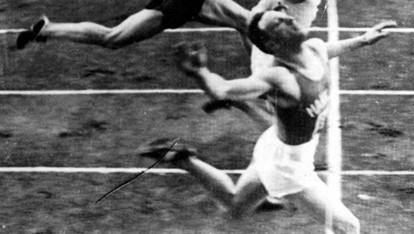
In Helsinki in 1938, Abraham Tokazier, a Jewish sprinter, won the 100 meter sprint. He was the gold medalist in his event, representing Finland’s Makkabi Sports Club. Tragically, the judges denied that he was the winner and, to their eternal embarrassment, the next day’s newspaper showed this photo on the front page, clearly presenting Tokazier as the winner. This anti-semitic scandal from the 1938 Helsinki Olympics still remains a sore spot for the Israeli sports community because it is such an over-the-top demonstration of corruption and oppression. Unlike the case of Tokazier’s stellar performance, we don’t need a photographer to advocate for us before our Judge when He evaluates our race. He knows the whole story and cannot help but rule justly. The record will not be graded on the curve, either. What we did for Him in His power will inevitably differ from what we did for ourselves or others in our own power. And the Lord will not make His evaluation on any other basis than the objective comparison with His absolute Righteousness and infinite love.

So God has set up the race; we run it. How marvelously simplifying is that for our lives?! We don’t have to register or even sign up. God took care of all the arrangements. The kind of race we’re talking about is not for the faint of heart—you’ll need endurance and focus. Also it is not a sprint. It is the long-haul, entire life, fully-committed, race of the disciple of Jesus Christ.

Like Harold Hoehner and Joe Goetz, your race will come to an end before you know it. No matter how long we have, this life is shorter than we think. And just like Tokazier’s undeniable photograph of the conclusion of his race, our Lord has a “photo” of every step we take—every thought, motivation, decision, and action. Your life matters enough in the grand scheme of things that God has scheduled an end-of-race review at the Judgment Seat of Christ (2 Cor 5:10). Your choices have eternal significance because the eternal God takes note of them. Combine that awesome significance with the very few opportunities in life to serve, and you might decide to get running. Are you running in such a way that you’re taking into account the ticking clock and the permanent record? If life is a race, then today is a step along the way. May you be strengthened “to run with endurance the race that [God has] set before you by looking away unto Jesus….”

Posted in Christian Suffering, Eternal Rewards, God the Father, New Testament Commands, Sanctification | Tagged , , , , , , | 1 Comment

“Peer” Leadership in Hebrews 12

The intention of this devotion is that we explore the commands of the Bible so that we will know our responsibilities. How will we obey the Holy Spirit if we are not listening to His instructions? The Bible gives us those instructions, and they come very clearly to us in the form of commands.  I think that we should be very careful about saying we are “listening to the Holy Spirit” If we are not actually paying attention to what we know for sure He has said.  Studying the Bible is hard work, but speculating about the validity of our inner leanings is easy.  Christians all too often give themselves a pass on the study of the Bible, and yet God keeps on being faithful to share Himsef with us there.  If we won’t spend the time in the gold mine we won’t find the goods.

 I think we should watch closely how God says things to us. Yes, we need to focus on what He says, but we also need to be mindful of how he says it. The way the writer of Hebrews issues the command we are studying in Hebrews 12:1-3 provides us with a crucial model for Christian leadership. The Biblical leader invites others to participate with him in the mission, and they march to that objective together.

Let us run with endurance the race set before us…. There is a kind of “leadership” that gets things done by relying on the “chain-of-command” and the authority vested in the office of the “leader.” That commander or manager tends to avoid identifying very much with those under him. Rather than saying “let’s get to work” his default approach is “you get to work.” Have you ever worked for the guy that says “Let’s get to work”? What about the other guy, “You get to work”? Most adults have experience with both kinds of leaders.

The “Get to Work” Manager

There is nothing wrong with division of labor. There is nothing wrong with a person having duly-constituted authority and issuing directives in the interest of the organization accomplishing its goals. That’s what effective leadership is all about: getting things done. In fact, not having effective leadership with necessary authority is wrong. “When in charge, take charge” may be a common maxim in the Army, but it is also Christian norm. We see it in the life and ministry of Jesus and His expectation of His disciples. Being anti-authority is being anti-Christian, and the legitimate exercise of authority does not amount to the abuse of authority. On the other hand, the legitimate possession of authority does not automatically certify a leader’s use of it, either.

Quick Takes: Office Space and Small Business

Sometimes we lose track of the fact that we are fallen and broken. Workers and bosses both forget that they themselves have shortcomings, especially when they examine the performance of the other. Arrogance is that sneaking, silent assassin that attacks us all and convinces us that we are better, smarter, and wiser than we are, regardless of the facts. Think about the effects of arrogance on both the leader and the follower. In the case of the person in authority, arrogance leads him to think he deserves his position and its power to make decisions. He is better than his subordinates. On the other hand, arrogance in the person under authority inevitably means he will resent those over him for their perceived inferiority to his wise perspective. He is better than his superiors. What a rotten curse is human arrogance! Humility in both the superior and the subordinate says “I am a sinner saved by grace in need of God’s constant mercy and guidance, and so is the other guy.”

The “Get to work” guy very often has forgotten his days sweeping the motor pool or emptying the boss’s trashcan. He did not respond to mechanical, disconnected commands when he was under a “get to work” kind of leader all those years ago. And while the best subordinates will perform well regardless of the leadership style of the boss, they perform best for a leader who connects with them and helps them be a part of the mission rather than a slave at the bottom of the totem pole.

Christian leadership is equipping the “subordinate” to join you in an endeavor which you are leading him through. This is how Jesus did it, and it is how the writer of Hebrews is doing it in Hebrews 12:1-3.

The “Let’s Get to Work” Leader
I will never forget the difference between field grade officers who brought me into their work and those who assigned me some busy work in which they had no interest in participating. It would be hard to overstate the difference their disposition toward me meant in terms of my motivation and even performance. Not that the manager-dictator would get less than my best effort; I was just more capable somehow when I was following someone who brought me into his endeavor and empowered me to run alongside him.

Beyond Band of Brothers: The war memoirs of Major Dick Winters

When the boss says, “Let’s get this done together,” and really means it, there is a sense of teamwork that calls every member of the organization out to do his part in the effort. Every little task becomes part of the big picture of their mission. The Division Commander is probably not going to peel your bushel of potatoes, but if he is wise, he will always talk about what “we” are doing in the big picture while reminding everyone under him that their diligence in their personal sector is contributing to the overall team effort.

A note of caution is in order here, if you are thinking of adopting this approach into your leadership style (and I heartily recommend that you do). Don’t fake it. Lots of people may fall for a phony but the best peers and subordinates will see through a manipulator trying to use a teamwork approach to work people. Genuine humility and a personal interest in the success of your teammates has a way of driving people farther and harder than a dictator-manager’s whip ever could.

The Apostles and “Peer” Leadership

The New Testament apostles and prophets often wrote with this “let’s get to work” ethos. They counted themselves in just as much need of spiritual growth and perseverance as those they were leading. Certainly Paul was farther along than his audience, but even he said his message was something he took special care to apply to himself:

1 Corinthians 9:26–27 Therefore I run in such a way, as not without aim; I box in such a way, as not beating the air; but I discipline my body and make it my slave, so that, after I have preached to others, I myself will not be disqualified.

When you read Hebrews 12:1, notice how the writer is lined up in the starting blocks right next to you: “Let us run with endurance the race set before us….” That cheers us on somehow. He has to do it too, and he’s bringing us along. When we get to heaven, won’t it be interesting to ask this writer—whoever he is!—how his race went? I suspect he did well, and so should we.

When thinking about those who run alongside us, we need to keep in mind even more the One who ran before us.  “Looking away unto Jesus, the author and perfecter of faith….”  The ultimate Exemplar for our race is Jesus, Who did it better and cleaner under worse conditions and greater opposition than we will ever know. Hebrews 12:3 says, “For consider Him who has endured such hostility by sinners against Himself, so that you will not grow weary and lose heart.”  Peer leaders can bring us a little encouragement; Jesus proofed the lane perfectly and paved a way for our perseverance.

My prayer for you continues to be that you will “wait upon the Lord” so that you may “run and not grow weary” and “walk and not faint. (Is 40:31)”

This entry is dedicated to the great leaders of 2BCT, 4ID from OIF-1 who taught me by their example to say, “Let’s get to work.” That was a team.

Posted in Army Leadership, Helping Others, New Testament Commands | Tagged , , | 4 Comments

Why It’s a RACE

We continue our sprint through Hebrews 12:1-3, a fantastic summary of our great journey through the Spirit-empowered Christian life. This passage is worthy of our repeated consideration and reflection. Some portions of the Bible really jump out at us, providing vital life-principles and rationales for our conduct of the Christian’s “worthy walk.” Have you ever thought in a time of great personal pressure, “I need peace now!” and gone to Philippians 4:6-7? Try it sometime. There’s an actual procedure for you to work through in prayer with the promise of peace from God Himself. What about the awesome utility of that central passage in the Law, Deuteronomy 6:4-5? Next time you find yourself thinking, “What is life all about anyway? What’s the point?” take that powerful medicine from Dr. Moses! It’s better than anything your MD can write you a scrip for. The thought process of 1 Peter 2:21-25 is one I like to mention a lot these days—a concrete way we can and must imitate Christ through suffering in His pattern. These little passages that really pack a punch need to be handy in our hearts, ready for deployment at a moment’s notice. Chunks of the Text like this are easy to memorize if you go to them repeatedly; you don’t even have to try.

In exploring the command in Hebrews 12:1-3 to “run the race that his set before us,” I want to focus on that word “race.”  This Greek word, AGON has come into English in the form of the word agony. It is only used a handful of times in the NT, always by Paul except in this case of Hebrews 12. While agony means suffering physical or emotional pain of some sort, the Greek word means some kind of struggle or contest. The NASB translates it variously by context as “fight,” “opposition,” “conflict,” “struggle,” and “race” as here. Yes, it can be agony to run up Mount Washington, so I’m told, but the origin of that word is not really the pain of the endeavor but the fight involved in mastering it.

As a pastor I love to point out where the Bible touches on our common experience and reflects life as we encounter it. In this case, everyone can agree that life is a struggle! It’s hard, just like a race or a fight.  In my limited athletic career, both in junior high school and college, I had a fairly consistent experience before a contest. Whether it was running the quarter mile (badly) in eighth grade or stepping up to a “graded bout” in Plebe boxing, the challenge of the engagement always made me feel sick. Adrenaline flooded my system, and the anticipation of the inevitable suffering involved made me wince for at least half of a day prior to the event.

In both types of contest, the suffering was primarily cardiovascular—sprinting a quarter mile all-out is a “gut race” that in the opinions of many should always result in the participant throwing up at the end. Boxing does involve getting hit in the head and midsection, but punches don’t hurt nearly so acutely during the fight as your lungs. Head shots do damage you will feel later, but they don’t “hurt” as the seconds tick by. Gasping for air hurts. My greatest fear in boxing was running out of air before the round ran out of time!

Both these cardio challenges required me to “keep up my wind.” If I ran the day before a boxing match, for some reason I had a better flow of energy when the bell rang.  A little stress-recovery cycle put me in position to perform the next day.  These events were high stress, and that stress was healthy. I did not like the feeling of impending suffering, but it helped me grow up and embrace the principle of rising to the occasion of duty that would require exertion and even cause pain.  I am still learning this daily.

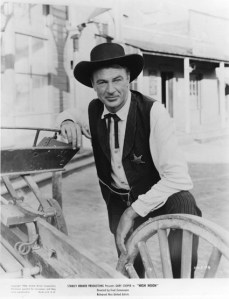
Featured image

The classic Western High Noon, starring Gary Cooper and Grace Kelly builds this sense of agonizing anticipation for about 90 minutes as Marshall Kane waits for the Frank Miller gang to come try to murder him in the street. Will Kane as a lawman is duty-bound to face the criminals while everyone around him tries to convince him to run and declines his requests for help. I don’t know of a better “man-up” movie that shows the contrast between those who get things done that need doing and those who make up excuses. America could use a little more Gary Cooper.

The writer of Hebrews calls the Christian life a race that has been set before us because he’s acknowledging that the struggle is hard. It hurts. It requires constant nutrition and exercise to “keep our wind up.” But think about that second wind! Have you ever had enough wind to get through a race or a bout? It feels awesome when you get into “the zone.” You perform at a high level, and though you may not win the contest against your opponents, you bring your body into submission and win the battle against your own weakness. Just like in High Noon, the release we will experience when our conflict is over will make the fight worth it. Our finish line in Hebrews 12:1-3 is when we meet our Savior. He ran a much more painful race without shrinking from the task, and he waits to greet us after our successful round.

Next time let’s equip ourselves to run by supplying endurance and removing distractions.

Posted in Uncategorized | 1 Comment

The Cloud of Witnesses and You

Is the performance of others supposed to have an impact on our Christian walk? We find the answer in the very helpful summary guidance of Hebrews 12:1-3, which focuses our attention on Jesus to equip us for “running.”

The main idea of this crucial chunk of Scripture is the command: “let us run the race that is set before us….” The first thing the writer of Hebrews gives us to support the race is a rationale: “Since we are surrounded by so great a cloud of witnesses let us run the race….” What witnesses? What do they have to do with my running well? In context Hebrews 11 gives a list of successful Old Testament believers. The point in every case is that these very real and flawed people trusted in God and His promises. The Bible presents these Old Testament saints as examples for our practice. The idea is “they did it; you can too.”

Maybe this is a new thought for you, but the concept of imitation is everywhere in The New Testament. Christians are imitators. We watch the success of others and emulate their successful approach. Not their personality, their failures, or even their experiences. We imitate their faith and their faithfulness.

The “cloud of witnesses” is composed of the OT heroes in Hebrews 11, warts and all. Can we take the principle of encouragement from those believers and apply it to believers in our time? Should I be encouraged by others’ success in trusting God? Yes! Hebrews 13:7 commands this: “Remember those who led you, who spoke the word of God to you; and considering the result of their conduct, imitate the faith.”

One important takeaway for your Christian walk in Hebrews is the impact we are supposed to have on one another. As an observer, look for good examples. You might find some at church! As an example, be mindful of those believers around you who might need to imitate your faith.

As you do consider others as examples to encourage your faith, remember that only Jesus is worthy of emulation as a perfect example. As with the sinful people in Hebrews 11, our fellow believers will drop the ball from time to time and should not surprise us or cause us to doubt. We need to acknowledge the hurt we feel when others fail and, in Christian love, expect and encourage them to recover. This is how we should treat one another and how we should be treated. You never know how your commitment to loving obedience of our Lord through such a troubling situation might provide a solid example of faith and faithfulness for those around you.

Next time we can explore the idea of the Christian life as a “race.”

Posted in Uncategorized | Leave a comment

Let Us Run! Hebrews 12:1-3

Spring is crawling in, and the runners are moving from the indoor to the outdoor track. I have found that running is a fantastic illustration of the Christian life.  Think about it: once you get serious and start going for it, there’s some unwelcome pain.  As you get better the pain gives way, not because you feel it any less but because your body gets stronger and better able to endure it. If you are consistent in your running, you will steadily improve, but only if you eat the right food and in the right quantity. The very exertion which takes so much out of you combines with rest to make you better and better at running. Your bones harden, your lungs become more efficient, your heart gets healthier, and your muscles strengthen—all because of a little pain.  You feel magnificent! Discipline in exercise results in consistency and endurance, and that pattern of success can become a healthy compulsion, if not an outright addiction.

God knows about the benefits of running. He made us and blessed the endeavor, just as sure as He created it. The writer of Hebrews uses running a race as a picture for living the Christian life:

Hebrews 12:1–3 (NASB95)

1Therefore, since we have so great a cloud of witnesses surrounding us, let us also lay aside every encumbrance and the sin which so easily entangles us, and let us run with endurance the race that is set before us,

2fixing our eyes on Jesus, the author and perfecter of faith, who for the joy set before Him endured the cross, despising the shame, and has sat down at the right hand of the throne of God.

3For consider Him who has endured such hostility by sinners against Himself, so that you will not grow weary and lose heart.

There is a lot here. Why don’t we unpack it over the next few weeks?

Here are some of the questions these three little verses answer:

  • Where may we find true-to-life examples for encouragement in our walk?
  • Why is the Christian life a race? Are we competing with others?
  • How did we get involved in running a race? Do you remember signing up?
  • How should we run?
  • Where will we find strength for running?
  • What should occupy our attention as we run?
  • How does our run relate to Jesus’ example?
  • What risk do we run if we fail to focus on our Savior?

If you’re like me, this study will leave you convinced that the dietary requirements to render you adequate for your race are not typical of popular Christian practice. The inevitable conclusion is a radical reorientation of our priorities. These priorities call for a follow-through in our expenditure of time. Maybe it’s time to stop drifting along in a fog of Christian disinterest and start running!

Posted in Christ as Example, Christian Suffering, Sanctification | Tagged , , , , , , , , , , | Leave a comment